Is Cary, NC Conservative or Liberal? What Home Buyers Should Know.
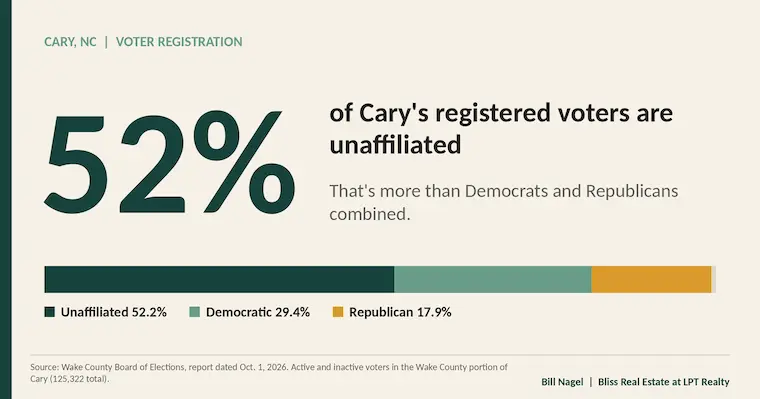
Cary is more mixed than the label suggests. As of October 1, 2026, 52% of its registered voters are unaffiliated, more than Democrats and Republicans combined. Among voters who pick a party, more register Democratic than Republican, and all seven town council members are registered Democrats, even though local elections are officially nonpartisan.
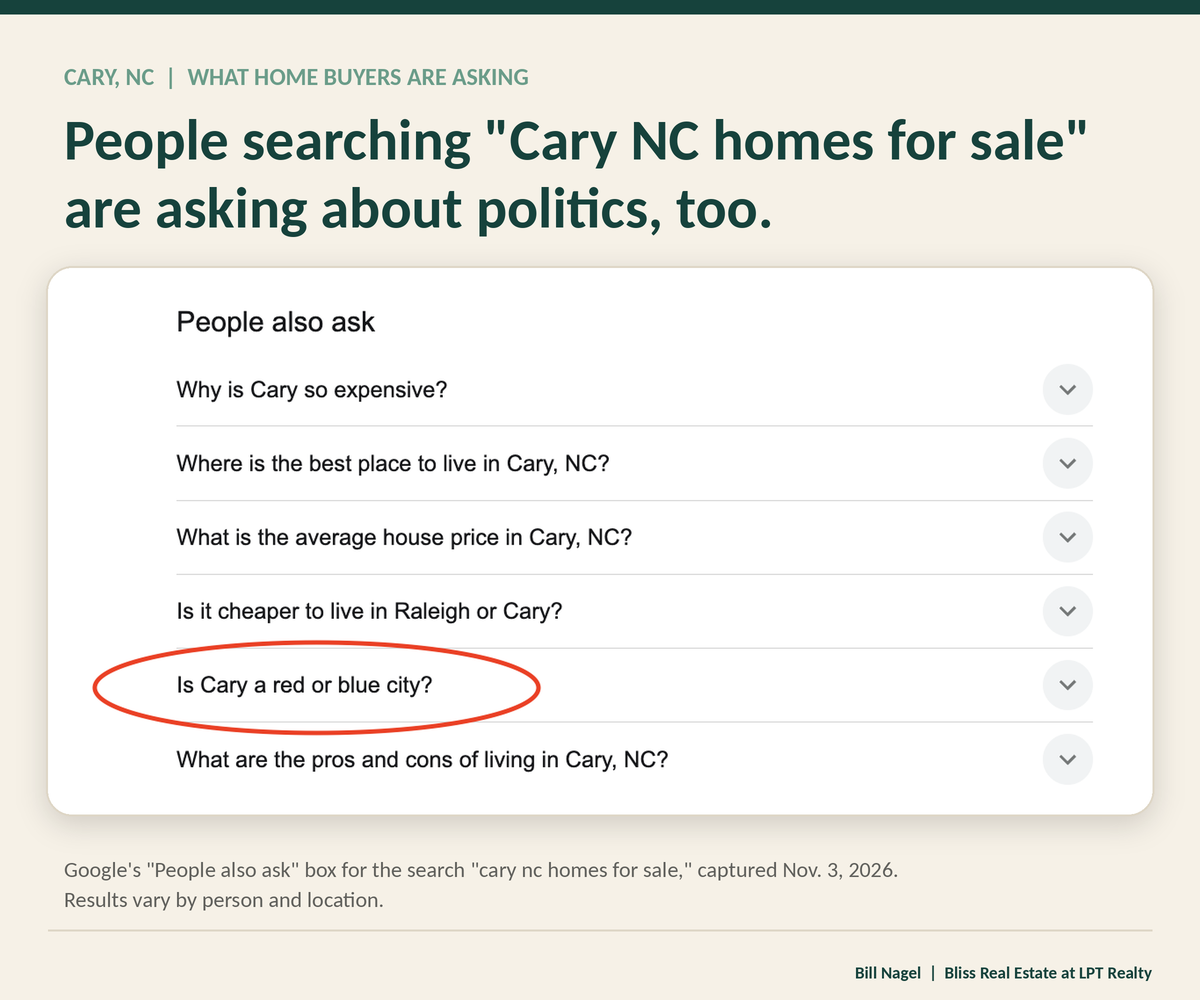
Here's what got me thinking. Search "Cary NC homes for sale" on Google, and the "People also ask" box includes the question "Is Cary a red or blue city?" (I checked on November 3, 2026.) These are people shopping for a home, asking about politics in the same breath as price and neighborhoods. I see the same thing in the related searches and in what people type into the search box on my own site, and I don't see it next to Raleigh or most other Triangle towns I track.
Quick timing note: today is Election Day (November 3), so yes, I'm publishing a politics post on the big day. Think of it as the one political thing on your screen today that won't ask you for a donation.
Here's a detail that surprises people: no Cary mayor or town council seats are on this year's ballot. Cary elects them in odd-numbered years, according to IndyWeek, so the last town election was November 2025 and the next is in 2027. The Wake County Board of Elections lists this year's contests as federal, state, county, and City of Raleigh.
A home buyer client asked me this in person recently, too. If you're deciding where to buy, you deserve a straight answer with sources, not a stereotype. Below are the numbers, who sits on the council, a few local things most buyers miss, and how to research any town yourself.
Last updated November 3, 2026. Sources: Wake County Board of Elections (report dated October 1, 2026, the county's latest as of this update), NC State Board of Elections, Wake County Tax Administration, and the Town of Cary.
Why Are So Many People Asking About Cary?
Cary keeps landing on best places to live lists. In May 2026, U.S. News & World Report named Cary the best place to live in North Carolina for the second year in a row, and No. 11 on its national list for 2026 to 2027, according to the Town of Cary's announcement. The Town also reports that Niche ranked Cary the best place to live in North Carolina for 2026.
That attention may be part of why this question keeps coming up. When people research a town from a distance, its political culture is one of the first things they want to understand.
What Does the Voter Registration Data Show?
The most direct public number is voter registration. As of October 1, 2026, the Wake County Board of Elections lists 125,322 registered voters in Cary, counting both active and inactive registrations.
|
Party |
Registered voters |
Share |
|---|---|---|
|
Unaffiliated |
65,379 |
52.2% |
|
Democratic |
36,796 |
29.4% |
|
Republican |
22,371 |
17.9% |
|
Libertarian |
676 |
0.5% |
|
Green |
100 |
0.1% |
|
Total |
125,322 |
100% |
Three things stand out:
- Unaffiliated voters are the largest group by a wide margin, and they outnumber Democrats and Republicans combined (65,379 versus 59,167).
- Among voters who register with a party, Democrats outnumber Republicans by about 1.6 to 1.
- For context, Wake County as a whole is 46.5% unaffiliated, 32.9% Democratic, and 20.0% Republican, so Cary's unaffiliated share is somewhat higher than the county's.
Registration shows how people chose to register, not how they vote or what they believe. In North Carolina, unaffiliated voters can choose which party's primary to vote in, so unaffiliated doesn't mean disengaged.
These counts cover the Wake County portion of Cary and include inactive registrations. Cary also extends into Chatham County, which isn't included here. I cross-checked the Wake County report against the NC State Board of Elections voter file, and the two agree to within about 0.1% (the state file shows 125,460). Shares are rounded.
Are Cary's Local Elections Partisan?
Officially, no. Cary elects its mayor and town council in November using the nonpartisan plurality method, which means the candidate with the most votes wins and party labels aren't part of the race.
In practice, candidates often run with party support. In 2025, each of the three council races had one Democratic and one Republican candidate, all endorsed by their county parties, according to IndyWeek. The Democratic candidates won all three seats.
Here is who sits on the council today and the party each member is registered under. Party registration is public record.
|
Member |
Seat |
Registered party |
|---|---|---|
|
Harold Weinbrecht |
Mayor |
Democratic |
|
Lori Bush |
At-large |
Democratic |
|
Carissa Kohn-Johnson |
At-large |
Democratic |
|
Brittany Richards |
District A |
Democratic |
|
Michelle Craig |
District B |
Democratic |
|
Bella Huang |
District C |
Democratic |
|
Sarika Bansal |
District D |
Democratic |
Source: NC State Board of Elections voter registration records and IndyWeek election coverage, as of October 2026. Party registration can change.
So the elected council currently leans Democratic, while most voters aren't registered with either party. Both facts are true, and together they answer the question better than either one alone.
A council's party registration doesn't tell you how it handles zoning, budgets, or services. Its agendas and minutes do, and I'll show you where to find them below.
Local Things Most Buyers Don't Know About Cary
Here's the stuff that rarely makes the listing description but shows up on your tax bill or your calendar.
- Cary votes in odd years. The mayor and council serve staggered four-year terms, and the last town election was November 2025. The mayor and several council seats are next up in 2027.
- Your tax bill has two big pieces. For the fiscal year that began July 1, 2026, Cary's town rate is 36.75 cents per $100 of assessed value, up from 34 cents. Wake County's rate is 53.71 cents. Add them together and you get about 90.5 cents per $100 (my math), before any special charges. On a $600,000 home, the town portion works out to roughly $2,205 a year.
- Wake County is revaluing every property on January 1, 2027. New value notices go out in January. After 2027, revaluations move to every two years, starting in 2029.
- Cary sits in three counties. Most homes are in Wake, but the town limits also reach into Chatham and Durham counties, and each county handles assessment and billing for its own portion. Check which county a specific address is in before you compare tax bills.
- A town manager runs daily operations. Cary uses a council-manager form, where the council sets policy and appoints the manager. The town has had an interim manager since December 2025, and the mayor described this year's budget as a response to a "breach of trust" over past financial reporting, according to WRAL. The council passed it unanimously, which is a good reminder that local votes don't always split along party lines.
- You can watch council meetings from your couch, or speak at them. Regular meetings are usually Thursday evenings at 6:30 p.m. in the Town Council Chambers at 316 N. Academy St. They stream live on Cary's YouTube, Facebook, and Cary Live, agendas post on the Agenda & Minutes Portal the Friday before, and public comment happens at regular meetings only.
- Cary 101 is the Town's citizen academy. It has run every year since 2003, and the 2026 session ran April through May with applications due in March.
What Does "Conservative or Liberal" Mean for a Town?
The label bundles three different things, and each has its own data.
- How residents register and vote. Registration numbers and election results show this, like the table above.
- How local government runs. The town council sets budgets, zoning, and services, and its agendas and minutes are public.
- What daily life feels like. Pace, walkability, commute, amenities, and the rules that touch your property, such as HOA covenants and local ordinances.
Most people asking the question are curious about the third, but they search using the first. The three can point in different directions, which is why a single label rarely fits a town.
That's also why I'd rather give you ways to check each one than tell you what to think about any of them.
How Can You Research Any Town Before You Buy?
This takes about an evening, and it works for any town, not just Cary.
- Pull the voter registration numbers. The NC State Board of Elections' Voter Registration Statistics Search breaks counts out by county and party and refreshes weekly. For town-level numbers, Wake County's monthly reports break out each municipality, including Cary. Note the report date and whether inactive voters are included.
- Look at election results. The State Board of Elections website posts results by county and race, so you can see how an area voted in state and national contests, not just how people registered.
- Read the council's agendas and minutes. They show what local government actually spends its time on. Cary posts them on its Agenda & Minutes Portal the Friday before each meeting, and the meetings stream live.
- Check the rules that touch daily life. Look at HOA covenants, local ordinances, and the zoning and development plans near any home you're considering.
- Visit twice. Go on a weekday during rush hour and again on a weekend, and run a real commute test to where you'd actually work.
That's a more reliable read than any label, and it's the same checklist I'd use in any town.
What Does This Mean for Your Home Search?
Labels are a weak filter for a home search. When someone types this question next to "homes for sale," what they're usually after is a picture of daily life, so concrete criteria narrow things down faster and tell you more about whether a place fits.
- Commute. Test the actual drive, at the times you'd make it, to the place you'd actually go.
- Walkability and pace. Some areas, like downtown Cary, put restaurants, the park, and the arts center within a short walk. Others are more car-oriented.
- Costs beyond the price. Compare the town and county tax rates (Cary's town rate is 36.75 cents per $100 and Wake County's is 53.71 cents this fiscal year), and remember Wake County revalues properties effective January 1, 2027. Ask about HOA dues too.
- Local rules and plans. Read the HOA covenants and local ordinances, and follow what's planned nearby. The projects in downtown Cary's pipeline move through a public process you can track.
- Schools. Confirm assignments for any specific address with Wake County Public Schools, since they vary block by block.
None of that requires knowing how anyone votes. It requires knowing what you want your days to look like.
If you want to see what's on the market while you research, browse current Cary listings. For the market side of the story, see what's happening at the top of Cary's market.
Frequently Asked Questions
Is Cary, NC conservative or liberal?
Cary is more mixed than the label suggests. As of October 1, 2026, 52.2% of its registered voters are unaffiliated, 29.4% are Democratic, and 17.9% are Republican, according to the Wake County Board of Elections. All seven town council members are registered Democrats, but local elections are officially nonpartisan.
Is Cary, NC Republican or Democrat?
Among registered voters who choose a party, more are Democratic (36,796) than Republican (22,371), but unaffiliated voters are the largest group at 65,379. Cary's mayor and town council are elected in nonpartisan races, and all seven current members are registered Democrats.
Are Cary's local elections partisan?
Officially, no. Cary elects its mayor and town council in November using the nonpartisan plurality method, so the candidate with the most votes wins and party labels aren't part of the race. In practice, candidates often receive county party endorsements, as they did in 2025.
Is there a Cary Town Council election in 2026?
No. Cary elects its mayor and town council in odd-numbered years, most recently in November 2025, so no Cary town seats are on the November 3, 2026 ballot. The next Cary municipal election is in 2027. Federal, state, and Wake County contests are on this year's ballot.
Who is on the Cary Town Council?
As of October 2026, the council is Mayor Harold Weinbrecht, at-large members Lori Bush and Carissa Kohn-Johnson, and district members Brittany Richards (District A), Michelle Craig (District B), Bella Huang (District C), and Sarika Bansal (District D). All seven are registered Democrats, according to voter registration records and news coverage.
How many registered voters are in Cary, NC?
The Wake County Board of Elections lists 125,322 registered voters in Cary as of October 1, 2026, counting active and inactive registrations in the Wake County portion of the town.
Is Wake County liberal or conservative?
Registration in Wake County as a whole is 46.5% unaffiliated, 32.9% Democratic, and 20.0% Republican, out of 866,052 registered voters as of October 1, 2026. Registration doesn't show how people vote, so check election results from the NC State Board of Elections for that.
What is Cary's property tax rate?
For the fiscal year that began July 1, 2026, Cary's town property tax rate is 36.75 cents per $100 of assessed value, up from 34 cents, according to WRAL. Wake County's rate for the same year is 53.71 cents, so the two add up to about 90.5 cents per $100, before any special charges.
When is Wake County's next property revaluation?
Wake County's next countywide revaluation takes effect January 1, 2027, and new value notices are mailed that month. After that, revaluations move to every two years, starting January 1, 2029, according to Wake County Tax Administration.
Where can I check Cary's voter and election data myself?
The NC State Board of Elections publishes voter registration data and election results, and the Wake County Board of Elections publishes registration statistics by municipality. The Town of Cary website lists council members and election details.
Thinking About a Move to Cary?
Tell me what pace, walkability, commute, and community feel you're looking for, and I'll help you find where that actually exists. Get in touch. If you're selling in Cary, buyers are researching these same questions about your town, and I can walk you through what your home is worth.
Bill Nagel has lived in the Cary area for more than 20 years and specializes in relocations to Cary, Raleigh, and the greater Wake County area. He works out of a downtown Cary office, a couple of blocks from the bungalow he once owned there (later redeveloped into row homes) that housed the office of Netsertive, his marketing startup, giving him a personal front-row seat to the redevelopment now reshaping the district. If you'd like help with your own search, get in touch or see what your home is worth in today's market.
Recent Posts



"Bill has a great experience in the triangle area and has a good understanding of the real estate. He is a great and a professional communicator. He is patient and persistent with our home buying journey and helped us secure the right property."
Nandasarathy
Talk With Bill Nagel